Food-based dietary guidelines - Australia
Official name
Australian dietary guidelines.
Publication year
The National Health and Medical Research Council released the new Australian dietary guidelines in February 2013. This is the fourth edition of dietary guidelines in Australia (first edition 1982, second edition 1992, third edition 2003). The next revision is scheduled for 2021.
The infant feeding guidelines were published first in 1996, with a revision in 2003 and again in 2012.
Process and stakeholders
The review process of the Australian dietary guidelines was led by a committee of The National Health and Medical Research Council and leading experts in the field of nutrition, public health, industry and consumer issues. This revision was also jointly partnered with and funded by the Commonwealth Department of Health.
The development of the infant feeding guidelines followed a similar process. They are based on the best available scientific evidence. Background dietary modelling and a comprehensive systematic literature review informed the revision of both sets of guidelines.
The Department of Health has ongoing responsibility to implement the guidelines.
Intended audience
The Australian dietary guidelines are aimed at the healthy population aged over 2 years. The document includes specific information for population sub-groups such as pregnant women, children or older adults where there are significant differences in nutritional requirements when compared to the general population.
The infant feeding guidelines are aimed at children under 2 years of age and include advice and recommendations on breastfeeding, supporting mothers and parents, and the introduction of solids. It covers relevant and common health-related concerns regarding infant feeding.
Food guide
Australia uses a guide to healthy eating that visually represents in a plate the proportion of the five food groups for recommended consumption each day. The food groups included in the plate are: grain cereal foods; vegetables and legumes/beans; fruits; lean meats and poultry, fish, eggs, tofu, nuts and seeds; reduced fat dairy products and/or alternatives. Outside of the plate there is the advice to drink plenty of water, and the recommendation to use oils in small amounts. Alcohol and highly processed foods (high in sugar, fat and sodium) should be consumed only sometimes and in small amounts.
Messages
The guidelines include five core recommendations which aim to direct people to the types and amounts of foods they should consume.
- To achieve and maintain a healthy weight, be physically active and choose amounts of nutritious food and drinks to meet your energy needs.
- Enjoy a wide variety of nutritious foods from these five groups every day:
- plenty of vegetables, including different types and colours, and legumes/beans
- fruit
- grain (cereal) foods, mostly wholegrain and/or high cereal fibre varieties, such as breads, cereals, rice, pasta, noodles, polenta, couscous, oats, quinoa and barley
- lean meats and poultry, fish, eggs, tofu, nuts and seeds, and legumes/beans
- milk, yoghurt, cheese and/or their alternatives, mostly reduced fat (reduced fat milks are not suitable for children under the age of 2 years).
- Limit intake of foods containing saturated fat, added salt, added sugars and alcohol.
- Encourage, support and promote breastfeeding.
- Care for your food; prepare and store it safely.
Food guide
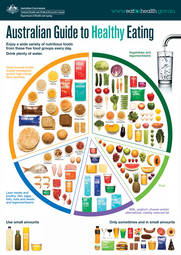
- The Australian guide to healthy eating
Country resources
Downloadable materials
- Australian dietary guidelines- Providing the scientific evidence for healthier Australian Diets (2013)
- Australian guide to healthy eating poster
- Eat for Health Educator Guide - Information for nutrition educators
- Indigenous Guide to Healthy Eating - Poster
Links