Desert locust response to mitigate impacts on food security and livelihoods

Feb 16, 2022, 14:35 PM
Title : Desert locust response to mitigate impacts on food security and livelihoods
Food and Agriculture Organization of the United Nations

My Site - EN

Desert locust response to mitigate impacts on food security and livelihoods

Desert locust response to mitigate impacts on food security and livelihoods in Kenya, Ethiopia, South Sudan and Uganda

dfdgdfg

©dfgdfgdfg

Project's full title Desert locust response to mitigate impacts on food security and livelihoods in Kenya, Ethiopia, South Sudan and Uganda
Introduction Desert locust response to mitigate impacts on food security and livelihoods in Kenya, Ethiopia, South Sudan and Uganda abstract here abstract here abstract here abstract here abstract here abstract here abstract here abstract here abstract abstract here abstract
Country Afghanistan Kenya
Start date 26/07/2020
End date 25/07/2021
Status new status
Budget fgdfgdfgfd
Project Code OSRO/GLO/020/RUS
Objective / Goal To limit the impact of desert locusts on agricultural production and food security in the targeted countries, supporting control efforts and safeguarding livelihoods.
Partners The Governments of Ethiopia, Kenya, South Sudan and Uganda through Ministries of Agriculture, and non-governmental organizations in Kenya and Uganda.
Beneficiaries Desert locust-affected farmers, agro/pastoralists and national authorities responsible for desert locust surveillance and control.
Activities

Ethiopia

  • Procured approximately 220 000 litres of ultra-low volume pesticides at the peak of the desert locust invasion.
  • Supported the leasing and operation of up to 357 flying hours of aircraft for the aerial survey and control of affected areas.

Kenya

  • Trained more than 900 technical officers and community scouts on topics including desert locust surveillance, good agricultural and livestock production practices, healthy nutrition, participatory rangeland management and prudent use of antimicrobials.
  • Distributed 25 000 chicks to 5 000 households, along with vaccines and feed.
  • Distributed 25 tonnes of fertilizer to farmers and rehabilitated 134 ha ofrangeland.
  • Distributed livestock feed to 4 000 households and supported pest and disease control for cattle, goats and sheep belonging to 12 060 households.
  • Supported 4 000 beneficiaries through unconditional cash transfers.
  • Distributed face masks to more than 20 000 households and installed 280 handwashing kits in 16 counties to limit the spread of coronavirus disease 2019 (COVID-19.)

South Sudan

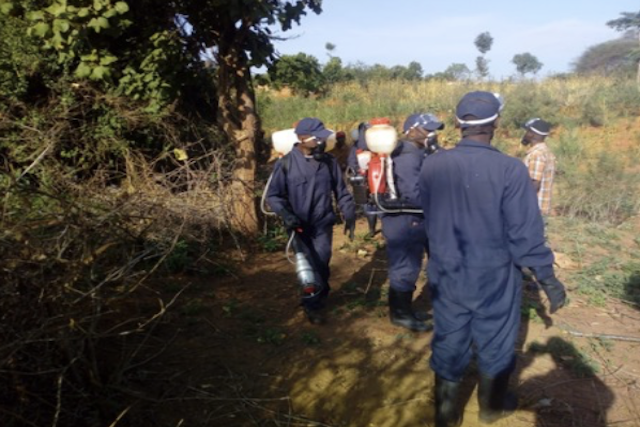
  • Procured equipment including motorized sprayers; pickup vehicles for mounted sprayers; motorbikes; smartphones with the eLocust3m app; binoculars; and entomology laboratory equipment.
  • Distributed pesticide and sprayers to frontline areas.
  • Supported mass community awareness campaigns, including radio broadcasts.
  • Trained 150 people for surveillance and control operations teams, and provided a training of trainers for 20 government staff on desert locust control.

Uganda

  • Provided livelihood assistance to 10 000 households, in the form of seed packages for 7 000 crop farming households, and livestock packages and vaccines for 3 000 agropastoral households.
  • Provided additional cash transfers and financial training for 4 900 of the most vulnerable of the 10 000 total beneficiary households.
  • Supported training on good agricultural practices and animal husbandry practices, including the creation of gardens for the demonstration of farming techniques and multiplication of seeds.
  • Procured vehicles, surveillance kits and camping gear to support desert locust surveillance and control operations.
Impact
  • Contributed significantly to desert locust control operations in the region, which treated more than 1 million ha across the targeted countries during the implementation period.
  • Averted the loss of 440 000 tonnes of crops in Ethiopia, valued at an estimated USD 130 million and sufficient to meet the annual cereal needs of 2.8 million people.
  • Established a strong desert locust taskforce in South Sudan and supported the development of a national five-year strategic plan to tackle desert locusts.
  • Contributed to protecting the livelihoods of more than 22 000 farming households in Kenya and Uganda, strengthening resilience by promoting sustainable production and financial literacy.
  • Enhanced government capacities in the targeted countries, providing technical knowledge and equipment that can serve in the event of another desert locust upsurge.
Contact fdgfgdfgf
Related publications
01/2022

This is an example of publication - abstract This is an example of publication - abstract This is an example of publication - abstract This is an example of publication - abstract This is an example of publication - abstract